

If you’re getting started with option trading in India, it’s important to know that your strategies will change depending on which segment you’re trading in. Options are contracts that give you the right, but not the obligation, to buy or sell an asset at a fixed price before a certain date.
But whether you’re dealing in equities, commodities, or currency pairs, the details differ quite a bit. In this guide, let’s give you insights into these differences so you can understand what to expect from each segment.
What are the Main Segments for Option Trading in India?
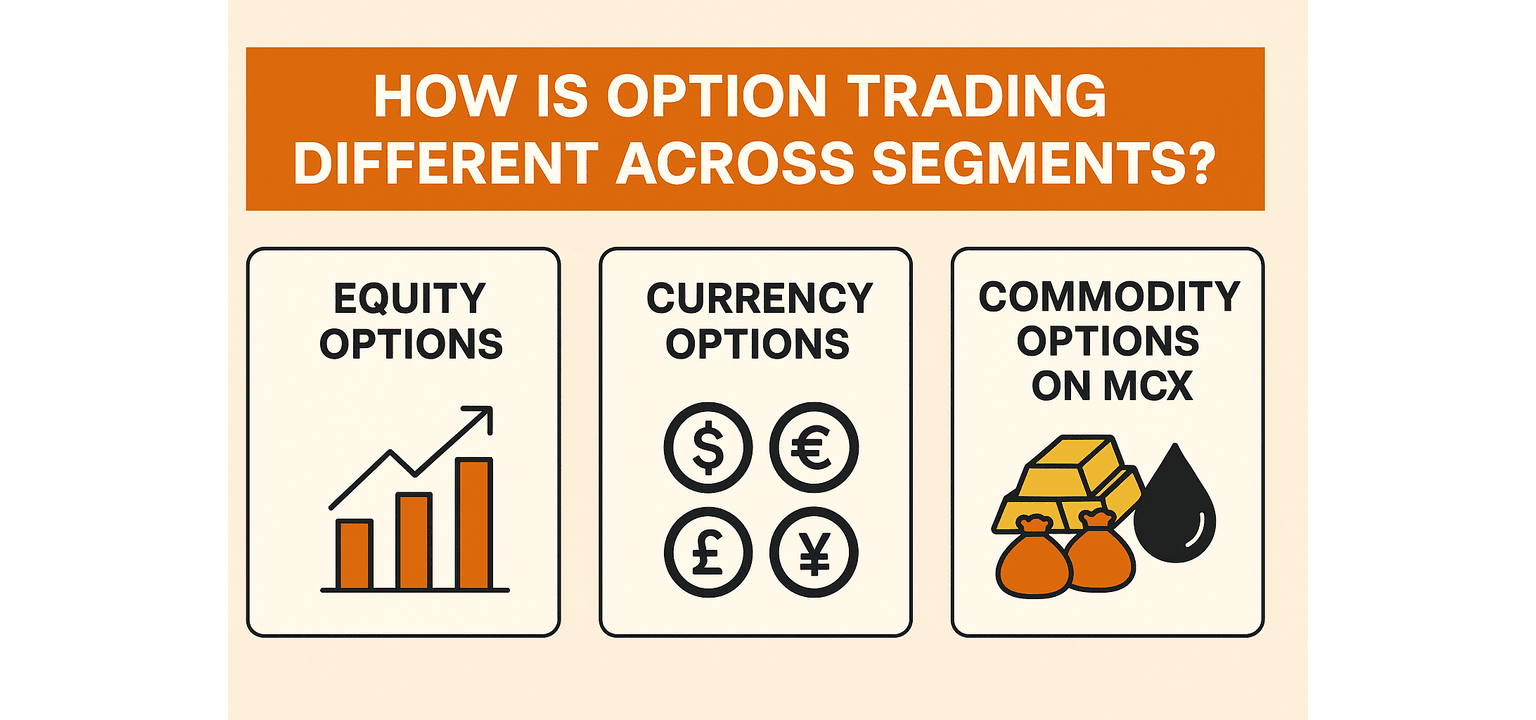
Option trading mainly takes place in three key segments in India: Equity Derivatives, Currency Derivatives, and Commodity Derivatives. They’re available on three major exchanges, the National Stock Exchange (NSE), the Bombay Stock Exchange (BSE), and the Multi Commodity Exchange (MCX). Each segment has its own set of rules, underlying assets, and trading features, which you need to know about before you start option trading.
Equity Options
Equity derivatives are the most popular. You can trade options on individual stocks of big companies and also on major indices like the Nifty 50 and Sensex. These options will let you place trades on how a stock or index will move without actually owning the shares.
In equity options, you typically trade contracts in lots. You pay a premium to buy options, and you can choose “call options” to place a trade on a rise or “put options” if you expect a fall. NSE and BSE are regulated by SEBI and offer features like lot size, expiry dates, and strike prices standardised for all traders.
Currency Options
Currency options let you trade options on pairs like USD/INR, EUR/INR, GBP/INR, and JPY/INR. These are a bit different because you’re dealing with forex rates rather than stocks. Currency options help businesses hedge currency risks, and speculators try to profit from currency fluctuations.
These are particularly useful if you’re keen on understanding India’s forex market dynamics and want to add global exposure without directly trading forex.
Commodity Options on MCX
Commodity trading options are traded mainly on MCX and let you trade contracts of assets like gold, silver, crude oil, natural gas, and base metals.
The key difference here is that MCX options are European-style, meaning you can only exercise them at expiry, unlike American-style equity options that can be exercised any time before expiry. Also, commodities often have different margin requirements and lot sizes.
Commodity options trading has grown rapidly in India, with MCX holding over 80% of the commodity derivatives market. This segment also involves understanding physical delivery rules, though most retail traders usually close positions before expiry.
Starting Your Options Journey
If you want to trade options across these segments, you’ll need to open a trading and demat account with a SEBI-registered broker offering F&O segment trading. Trading in equity might be more familiar and easier to start with due to higher liquidity and more educational resources.
Commodity options can be a diversification play, but require an understanding of commodity markets and expiry mechanics. The same goes for currency options. No matter which segment you choose, always start small, use demo accounts to practice, and understand the risks.
Conclusion
Option trading varies widely across equity, currency, and commodity segments. Each segment has unique features, risks, and opportunities. As you explore, understanding their differences will help you align your trading with your risk-taking ability and goals.
Keep in mind that options trading is about research, strategy, and discipline, not just luck. Keep learning, start cautiously, and use the resources available on official exchange websites like NSE, BSE, and MCX to stay updated on the products and rules. Happy trading!
Curious for more? Dive deeper on our site now! News Well
