
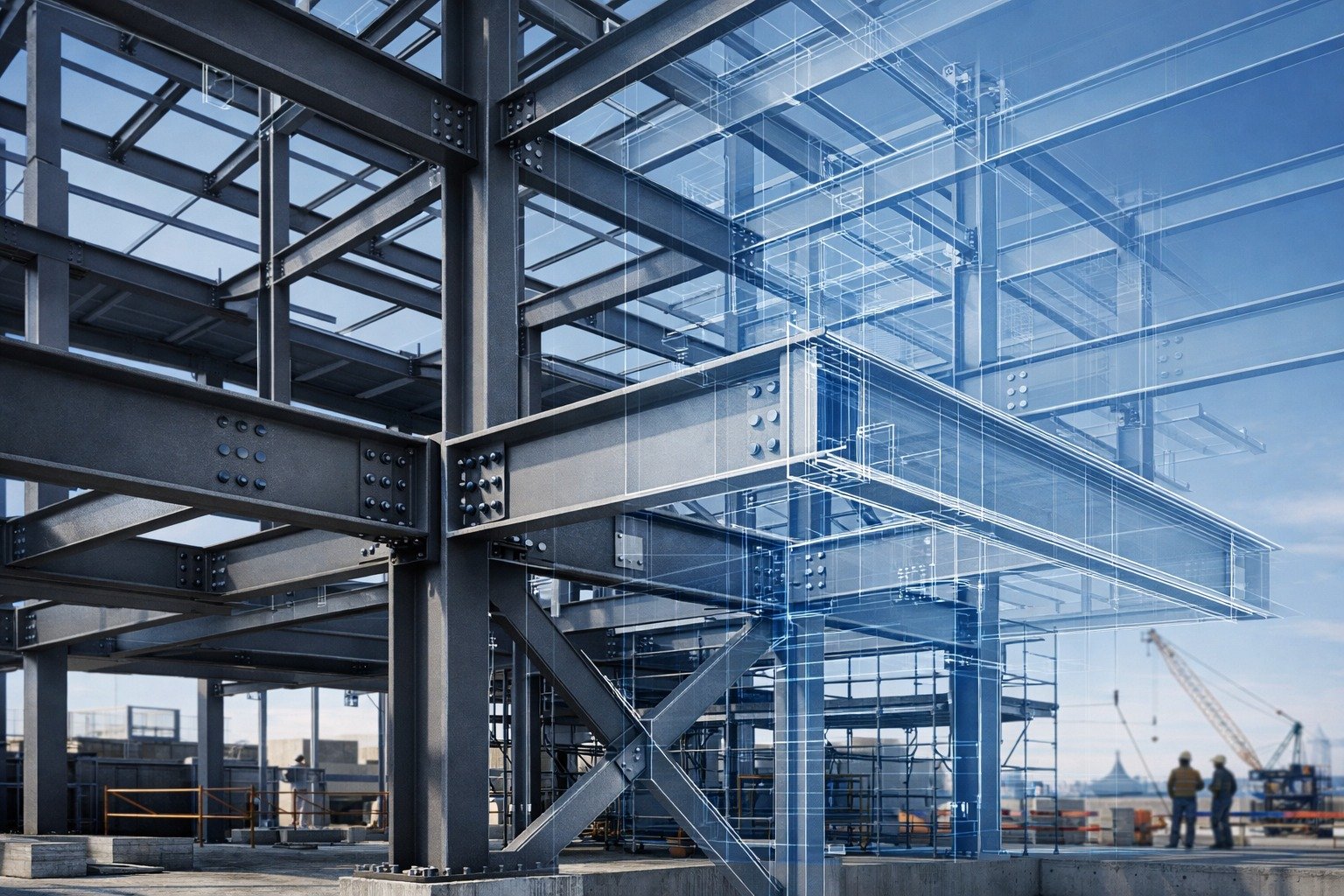

Structural steel projects operate within tight margins for error. Small inaccuracies in design interpretation, detailing, or coordination can cascade into fabrication delays, costly rework, and on-site conflicts that disrupt schedules and budgets. As projects increase in complexity—driven by architectural ambition, accelerated delivery methods, and integrated project teams—the industry has moved beyond traditional 2D documentation toward data-rich, model-based workflows.
Structural steel modeling sits at the center of this shift. By translating design intent into precise, constructible digital representations, steel models serve as the connective tissue between engineering, fabrication, and erection. When implemented correctly, they do more than visualize steel frames; they actively improve decision-making, coordination, and execution across the project lifecycle.
Understanding Structural Steel Modeling in a BIM Context
Structural steel modeling is the process of creating a detailed, three-dimensional digital representation of a steel structure that includes members, connections, plates, bolts, welds, and associated metadata. Unlike conceptual or schematic models, steel models are developed to fabrication-level accuracy, often serving as the direct source for shop drawings and CNC data.
Within modern BIM workflows, structural steel modeling bridges the gap between structural design models and real-world fabrication constraints. Engineers may define member sizes and load paths, but steel models refine this information to reflect how components are actually manufactured, transported, assembled, and erected.
In practice, these models support a range of downstream activities, including:
- Generation of shop and erection drawings
- Automated material takeoffs and bills of materials
- CNC and robotic fabrication data
- Construction sequencing and lift planning
- Multidisciplinary coordination with architectural and MEP systems
For many projects, this modeling scope is delivered through specialized structural steel modelling services that align engineering intent with fabrication and construction realities. The value lies not in the software itself, but in how accurately and intelligently the model reflects both design requirements and production constraints.
Improving Fabrication Accuracy Through Model-Based Detailing
Fabrication accuracy is one of the most tangible benefits of structural steel modeling. Traditional detailing methods rely heavily on manual interpretation of 2D drawings, increasing the risk of dimensional errors, mismatched connections, and incomplete information. Steel models significantly reduce these risks by embedding precision directly into the digital environment.
Accurate Geometry and Tolerances
Steel models define exact member lengths, cope dimensions, hole locations, and connection geometries. Because all elements exist within a coordinated 3D space, dimensional conflicts are identified early rather than discovered on the shop floor. Fabricators gain confidence that what they produce will fit as intended during erection.
Direct-to-Fabrication Data
Modern fabrication equipment can read data directly from steel models, enabling automated cutting, drilling, and welding processes. This reduces manual data entry and the errors that often accompany it. Consistency between the model and fabricated components improves overall quality and repeatability.
Reduced Ambiguity in Detailing
Well-developed steel models remove guesswork. Connections are explicitly defined rather than implied, and special conditions—such as slotted holes, camber requirements, or erection aids—are documented within the model. This clarity minimizes back-and-forth between fabricators and engineers, keeping production moving efficiently.
Reducing Errors and Rework Before They Reach the Site
Errors in steel projects are expensive not because they exist, but because they are often discovered too late. Structural steel modeling shifts error detection upstream, where corrections are faster and far less costly.
Early Issue Identification
By modeling steel components in three dimensions, discrepancies between design intent and constructability become visible early. Common issues identified at the modeling stage include:
- Conflicting member elevations
- Inadequate access for bolting or welding
- Overlapping connection components
- Misaligned embeds or anchor bolts
Resolving these issues digitally prevents physical rework and site delays.
Consistency Across Documentation
When shop drawings, material lists, and CNC files are all derived from a single coordinated model, inconsistencies are dramatically reduced. Changes made in one location propagate throughout the documentation set, lowering the risk of outdated or contradictory information circulating among teams.
Change Management Control
Design changes are inevitable. Steel models make it easier to assess the impact of revisions by visualizing affected components and quantities. This supports faster decision-making and more accurate cost and schedule adjustments, reducing the likelihood of surprise impacts during fabrication or erection.
Enhancing Coordination Between Design, Fabrication, and Erection Teams
Steel projects succeed when information flows smoothly between disciplines and stakeholders. Structural steel modeling functions as a shared reference point that aligns expectations and responsibilities across teams.
Alignment with Structural Engineering Intent
Steel models interpret engineering calculations into buildable elements while preserving load paths, connection capacities, and performance criteria. Close coordination between engineers and modelers ensures that detailing decisions do not compromise structural integrity.
Fabricator and Erector Input
Experienced fabricators and erectors bring valuable insight into how steel is handled, assembled, and installed. Incorporating their feedback during the modeling phase improves constructability by addressing issues such as splice locations, shipping constraints, and erection sequencing.
Improved Communication
Visual models communicate complex conditions more effectively than 2D drawings alone. Project managers, site supervisors, and non-technical stakeholders can quickly understand framing relationships, connection logic, and installation sequences, reducing misunderstandings and misaligned assumptions.
Supporting Clash Detection and Multidisciplinary Coordination
Structural steel rarely exists in isolation. It must coexist with architectural features, mechanical systems, electrical routing, fire protection, and building envelopes. Structural steel modeling plays a critical role in identifying and resolving spatial conflicts across these systems.
Proactive Clash Detection
By federating steel models with architectural and MEP models, teams can identify clashes before construction. Typical coordination issues include:
- Ductwork intersecting beams or braces
- Equipment requiring clearance within steel bays
- Conflicts between steel and façade support systems
Addressing these conflicts early avoids field modifications that compromise quality and schedule.
Resolution with Constructability in Mind
Because steel models reflect fabrication-level detail, clash resolutions can consider real-world constraints. Adjustments are evaluated not only for spatial clearance but also for their impact on fabrication complexity, connection design, and erection feasibility.
Reduced Field Coordination Burden
When clashes are resolved digitally, on-site coordination demands decrease. Trades can work more predictably, and site teams spend less time resolving unexpected conflicts, improving overall productivity and safety.
Improving Scheduling, Sequencing, and Constructability Planning
Beyond geometry, structural steel modeling supports time-based planning and construction logistics, particularly when integrated with scheduling data.
Model-Based Sequencing
Steel models can be used to visualize erection sequences, helping teams plan crane operations, temporary bracing, and access strategies. Sequencing decisions made during modeling often result in safer and more efficient site operations.
Logistics and Delivery Planning
Accurate quantities and component groupings derived from models support just-in-time delivery strategies. Fabrication and shipping can be aligned with erection schedules, reducing site congestion and material handling risks.
Constructability Reviews
Steel models enable constructability reviews that go beyond theoretical design compliance. Teams can evaluate:
- Feasibility of bolted and welded connections
- Access for tools and personnel
- Stability during intermediate erection stages
These reviews reduce on-site improvisation and enhance overall build quality.
Data Continuity Across the Project Lifecycle
One of the less visible but most impactful advantages of structural steel modeling is data continuity. Information embedded in the model supports decision-making beyond fabrication and erection.
Accurate Quantification and Cost Control
Reliable material quantities improve cost forecasting and procurement planning. Changes in design or scope can be quantified quickly, supporting transparent cost control.
As-Built Documentation
Updated steel models can serve as accurate as-built records, supporting facility management, future renovations, or structural assessments. This long-term value is often overlooked during project delivery but becomes significant over the building’s lifespan.
Integration with Digital Project Delivery
Steel models contribute to broader digital delivery strategies, including model-based handover and asset information management. Consistent data standards improve interoperability across platforms and stakeholders.
The Strategic Value of Structural Steel Modeling
Structural steel modeling is not simply a detailing exercise; it is a strategic tool that improves outcomes across fabrication, coordination, and construction. By embedding precision, constructability, and collaboration into a single digital environment, it addresses many of the root causes of inefficiency in steel projects.
Projects that leverage well-executed steel models benefit from higher fabrication accuracy, fewer errors, smoother coordination, and more predictable site execution. As BIM-driven delivery becomes the norm rather than the exception, structural steel modeling will continue to define how successfully teams translate design intent into built reality—efficiently, safely, and with confidence.
Meta Title:
Fabrication-Ready Steel Models That Boost Site Coordination
Meta Description:
When steel models reflect real fabrication constraints, teams gain cleaner connections, fewer field fixes, and tighter coordination from shop to site
