
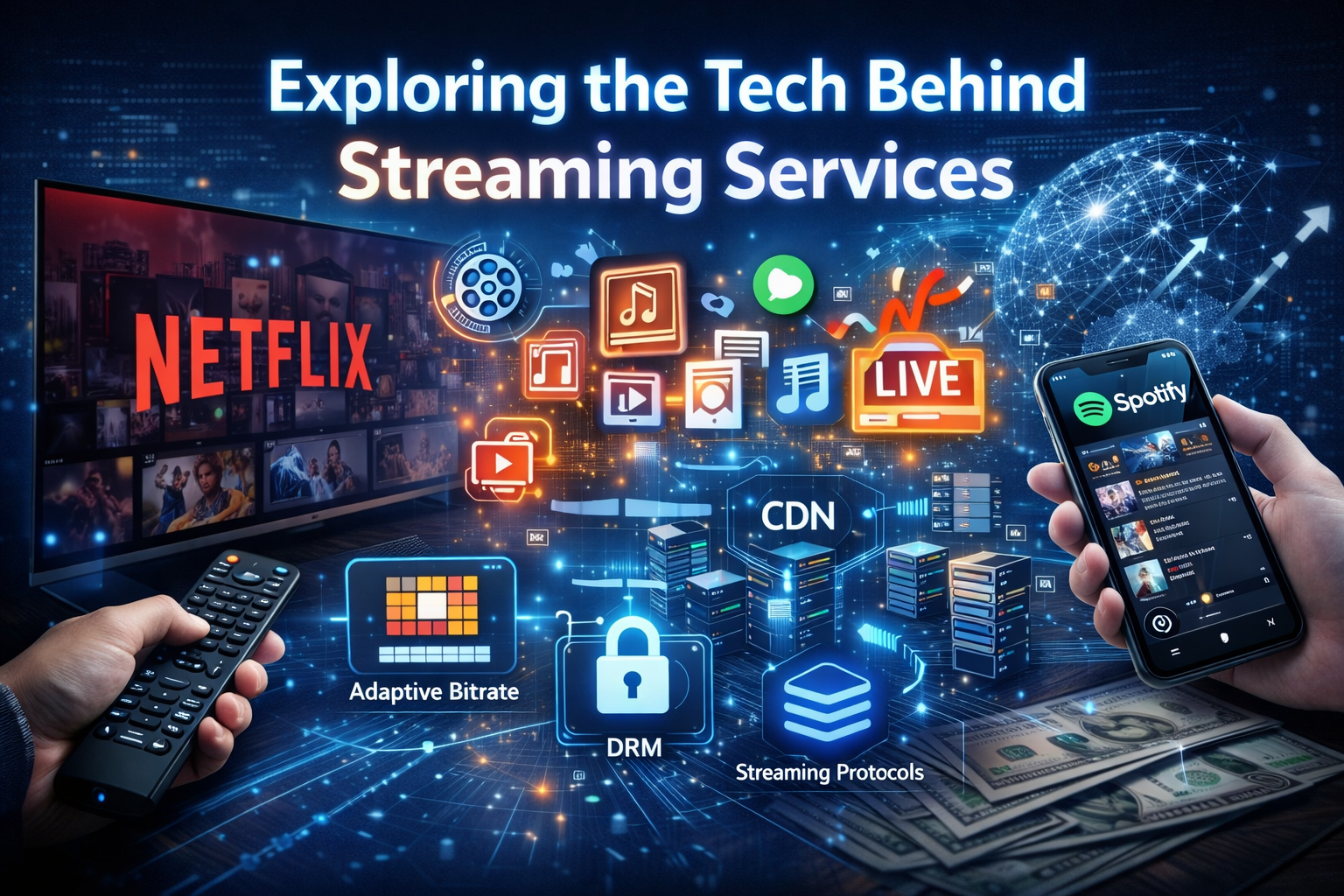

From Netflix shows and films to the hottest new Spotify tracks and many more in between, streaming services dominate the way we entertain ourselves, don’t they?
We can access a huge ocean of content that we love within seconds, enjoy tailored suggestions or playlists, and sometimes even choose the way we want the interface to look. Behind all these features isn’t magic. Instead, a bunch of advanced technologies work together like a well-oiled machine to ensure a smooth experience.
How? Let’s find out!
In this article, I’ll briefly explore what streaming is and then dive into the technologies behind it and how they make streaming the great experience that it is.
What is Streaming?
In short, streaming is a way to consume various forms of content, such as music, movies, and more, without having to store them locally on your device. Instead, the content is loaded to your device in small chunks as you’re watching or listening in real time.
Streaming platforms require an internet connection to work, as a continuous flow of data has to be transmitted on the web in real time. This doesn’t just create the need for an internet connection; it creates the need for a fast, reliable, high-bandwidth, and low-latency internet connection.
So, if you’re looking to enjoy streaming anytime soon, you might want to make sure you have that in order. I recommend you look into Verizon 5G internet, as they offer affordable, yet fast and reliable home internet.
Streaming can take various forms, the most common of which I’ve broken down below:
- On-demand Streaming: Access content anytime you like, without downloading it.
- Live Streaming: Watch events as they happen.
- Progressive Streaming: Simultaneous downloading and playback.
- Real Time Streaming: Real-time communication, such as gaming or video calls.
- Audio Streaming: Only audio streaming.
- Adaptive Bitrate Streaming: Allows stream quality to adjust based on internet speed.
Now that you know what streaming is and the various forms it can take, let’s explore the technologies that make each of these forms possible and how they work.
The Tech Stack Behind Streaming Platforms
With most streaming services, the technologies below perform a specific function to ensure the experience is smooth and secure. Let’s take a look.
Video and Audio Compression (Codecs)
Video or audio content files in their raw form are very large and difficult to stream efficiently, which means they need to be compressed for smooth and easy streaming. Video and audio compression technologies called codecs handle this task.
These technologies compress raw files into transmittable sizes, in turn making it easier for your device to receive and decode the data. Some of the most common forms of audio and video codecs include the ones mentioned below:
- Advanced Audio Codec (AAC): Removes inaudible sound data, leading to better sound quality and smaller file sizes. It is most commonly used by streaming services such as Apple Music and YouTube.
- H.264 Advanced Video Compression (AVC): This is the most used video codec, known for its efficient file compression without quality disruption. This might explain why streaming giants such as Netflix and YouTube use it.
- H.265/High Efficiency Video Coding (HEVC): This is the successor to AVC and can compress data more efficiently, allowing it to support activities such as 4K and 8K streaming.
- VP9: An open-source codec developed by Google that can support efficient streaming and high-quality video playback, including 4K and 8K, with a lower bandwidth.
Digital Rights Management (DRM)
After the video and audio codecs encode and package the data, digital rights management software controls access to premium content and helps prevent the unlawful or unauthorized use and distribution of content.
How they work is that each time you watch or listen to protected content, the DRMs encrypt the content stream, and only users who have paid or subscribed can listen to or view, preventing illegal sharing or downloads and piracy.
Some of the most well-known DRMs include:
- Google Widevine
- Apple Fairplay
- Microsoft PlayReady
- Watermarking
Content Delivery Networks (CDNs)
Once the content has been encoded, packaged, and protected, the next step is to deliver it to the user’s device efficiently. Doing this from an in-house server presents challenges like higher latency, since the distance the data has to travel is higher.
On the bright side, Content Delivery Networks (CDNs) can help add some efficiency to the process.
These are a distributed network of servers that process and deliver content from the server nearest to the user instead of the streaming platforms’ servers. This reduces the data transmission distance, lowers latency, and boosts playback speed.
Some of the most popular CDNs, I’m talking those used by platforms such as Netflix and YouTube, include:
- Akamai
- Cloudflare
- Amazon CloudFront
Streaming Protocols
Once the CDN receives the content, the next step is delivering it to the user.
This involves breaking it down into smaller chunks, transmitting it from the server to your device using the internet, and reassembling it for continuous playback. This is where streaming protocols streamline the whole process.
They are basically a set of instructions that define how each of the previously mentioned tasks will be carried out, for maximum efficiency. There are 4 main streaming protocols, each of which supports different types of content.
These include:
- HTTP Live Streaming (HLS): This breaks video data into small chunks and transmits it over the HTTP/HTTPS protocol, allowing adjustments to video quality based on your internet speed, making it ideal for video streaming on your devices.
- MPEG-DASH: This splits video into small chunks and delivers different versions with different bitrates over HTTP/HTTPS. It works with multiple codecs, making it perfect for adaptive streaming.
- RTMP (Real-Time Messaging Protocol): This delivers encoded data from an encoder to a server, which then distributes it to viewers, using Transmission Control Protocol (TCP). It is known for low latency and consistency, making it ideal for live streaming content such as sports or news.
- WebRTC (Web Real-Time Communication): This is an open source that uses JavaScript APIs to support direct exchange of data between servers and devices. It is ideal for gaming, video streaming, or communication.
Video Players
These are the final software in the mix that decode the data transmitted and display it on your device’s screen.
The video player receives data chunks from the CDN or server and uses a codec to decode them, then displays them on your screen. These players can also adjust video quality based on your internet speed to manage load times and ensure a smooth experience.
Some of the most common types of video players include:
- YouTube Player
- Custom Video Players, like those that Spotify and Netflix use
- HTML5 Video Players, which work best with most internet browsers.
Streaming – A Marvelous Combination of Technologies
We often watch and listen to our favorite movies and music for hours on end, thanks to a seamless cohesion among a large range of technologies. As the power of these technologies grows and combines with others like Artificial Intelligence (AI) or Virtual Reality (VR), we may soon be able to enjoy the next wave of high-quality streaming experiences.
Curious for more? Dive deeper on our site now! News Well
