

Native advertising has become one of the most reliable paid traffic channels for marketers who want scale without relying entirely on search or social platforms. Unlike traditional banner ads that users often ignore, native ads blend into the look and feel of the websites where they appear—making them less intrusive, more clickable, and often cheaper to test at volume.
But buying native traffic successfully isn’t about “turning on a campaign and hoping for the best.” The difference between profitable native campaigns and money-burning experiments comes down to preparation, tracking, creative strategy, and optimization discipline.
In this guide, we’ll break down how to buy native ads traffic the right way, what mistakes to avoid, and how experienced media buyers approach scaling in 2025.
What Is Native Ads Traffic?
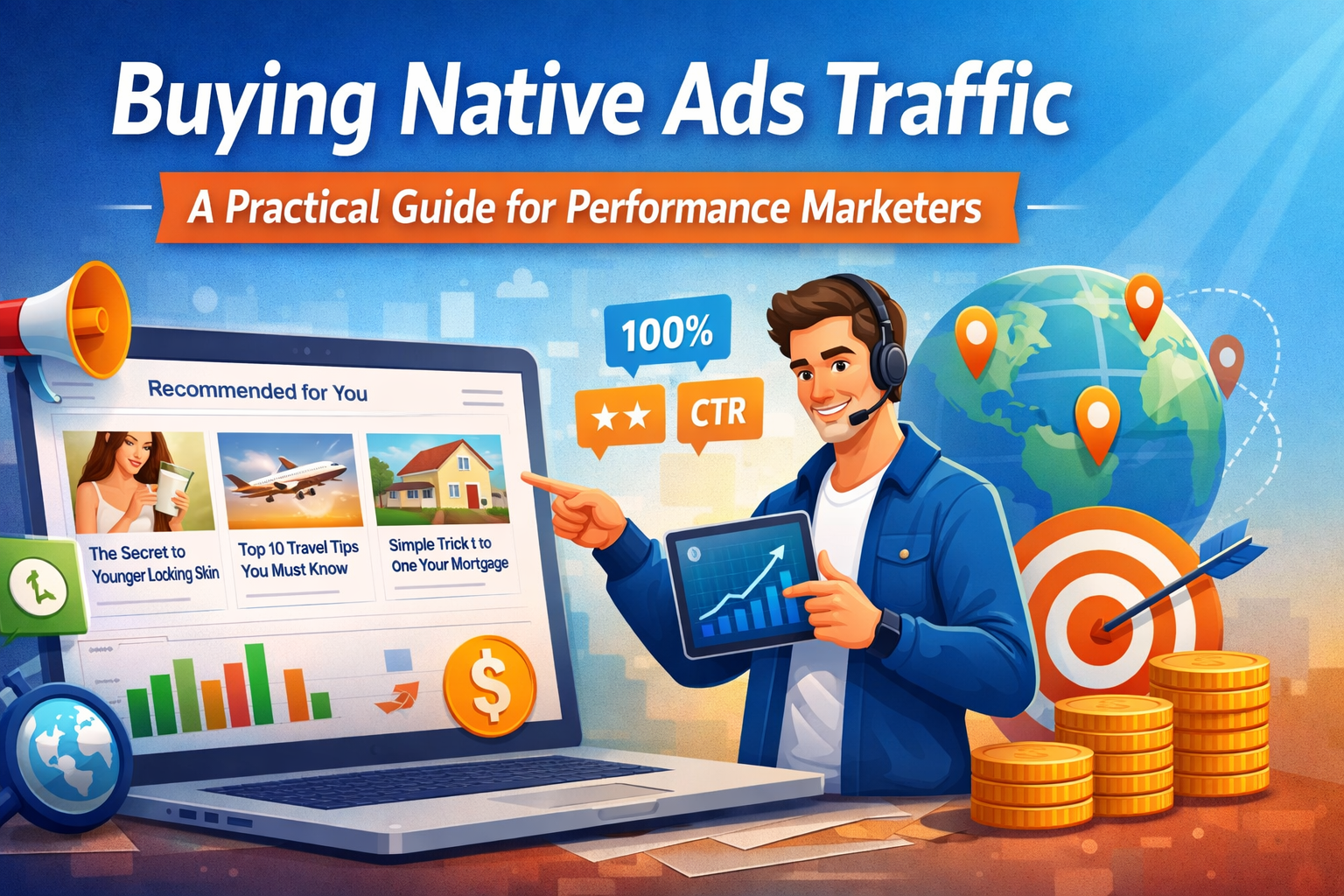
Native ads are paid placements designed to match the format of the surrounding content. Most commonly, they appear as recommended articles or content blocks on news sites, blogs, and publisher networks. You’ll often see them under sections like:
- “Recommended for you”
- “From around the web”
- “You may also like”
Native ads traffic refers to visitors coming from these placements—usually after clicking a headline and image combination that looks like a content suggestion rather than a standard advertisement.
Native traffic can be powerful because it’s driven by curiosity and interest, not interruption. That said, it’s also a channel where poor targeting and weak landing pages can drain budgets quickly.
Why Performance Marketers Still Love Native Ads
Native ads have been around for years, but they continue to attract affiliate marketers, app advertisers, lead generation teams, and e-commerce brands for a few simple reasons:
1) High volume, global reach
Native networks often provide access to massive publisher inventory across multiple countries. If you’re trying to scale beyond a single GEO or avoid dependence on one platform, native offers a strong alternative.
2) Great for cold audiences
Native placements work well at the top of the funnel. They’re ideal for offers that need storytelling, education, or curiosity-driven angles.
3) Strong testing environment
You can test multiple headlines, images, and landing page hooks quickly. With the right process, native becomes a repeatable creative-testing machine.
Step 1: Start With the Right Offer + Funnel Match
Before you spend a dollar, confirm your offer makes sense for native traffic. Native users behave differently than search users:
- Search traffic often has intent (“buy”, “best”, “review”)
- Native traffic is more discovery-based (“what is this?”, “why is everyone talking about it?”)
Native works best for funnels that can “warm up” users quickly, such as:
- Lead gen (insurance, finance, education)
- Affiliate content funnels (review pages, comparisons, quiz funnels)
- Health & beauty with strong advertorial angles (compliance required)
- Utility apps and subscriptions with clear value propositions
If your offer requires high intent instantly, native may struggle unless you use pre-sell content or a bridge page.
Step 2: Tracking Is Non-Negotiable
If you don’t track properly, native advertising will feel random. If you do track properly, it becomes one of the most controllable traffic sources available.
At minimum, you should have:
- A tracker or analytics system (campaign → ad → placement level)
- Conversion tracking on the offer page
- UTM parameters or click IDs
- Postback (S2S) tracking if possible
The reason is simple: native success depends on cutting losers fast and feeding winners. Without clean data, you won’t know which placements, creatives, or segments are driving ROI.
Step 3: Creative Strategy—Headlines and Images Matter More Than You Think
Native is a creative-first channel. Your targeting matters, but creative is what determines:
- Click-through rate (CTR)
- Cost per click (CPC)
- Traffic quality
- Whether you scale or stall
Native headlines that work usually follow patterns like:
- Curiosity + benefit: “This Simple Tool Is Changing How People Save Money”
- Problem/solution: “Struggling With Sleep? Try This Before Bed”
- Data/authority: “Doctors Are Talking About This New Method…”
- Time-based hooks: “What’s Working in 2025 Might Surprise You”
Images should be:
- Clear, high contrast
- Easy to understand at small sizes
- Emotionally relevant (not random stock photos)
- Aligned with the landing page promise
One of the biggest mistakes beginners make is using “pretty” creatives instead of “effective” creatives. Native ads aren’t about design awards—they’re about performance.
Step 4: Landing Pages That Convert Native Users
Native traffic often needs context. Sending users straight to a hard-sell page can work sometimes, but more often you’ll see better results with:
- Advertorial-style pages
- Review pages
- Comparison pages
- Quiz funnels
- Simple “bridge pages” that pre-frame the offer
Your landing page must match the ad’s message. If your headline suggests a helpful guide and the user lands on a pushy sales page, you’ll lose trust instantly.
Key landing page elements that improve conversion:
- Strong above-the-fold hook (headline + subheadline)
- Skimmable layout with short paragraphs
- Proof elements (stats, testimonials, screenshots)
- One clear call-to-action (CTA)
- Fast load speed (especially on mobile)
Step 5: Optimization: How Pros Scale Native Campaigns
Native ads are not “set and forget.” The best media buyers optimize in cycles:
1) Test phase (learning mode)
- Launch multiple creatives (5–10 variations)
- Start with broad targeting
- Gather enough clicks/conversions to judge performance
2) Cut phase (remove waste)
- Block poor placements
- Pause low-performing ads
- Reduce spend on segments with high CPA
3) Scale phase (double down)
- Increase budget gradually (not instantly)
- Clone winning campaigns into new GEOs
- Expand with new creatives based on winners
Scaling without fresh creatives is one of the fastest ways to kill a profitable campaign. Native audiences burn out quickly, so creative rotation is a must.
Choosing the Right Native Advertising Partner
Not all networks are equal. The network you choose affects:
- Inventory quality
- Approval speed
- Targeting controls
- Reporting transparency
- Support and optimization help
If your goal is consistent traffic monetization and scalable media buying, it helps to work with a network that understands performance marketers not just brand advertisers.
For advertisers looking to buy native ads traffic, it’s important to choose a platform with strong inventory access, flexible campaign controls, and support that matches your experience level.
A good example of a solution built for modern performance needs is Advanced Advertising Network, which offers advertising formats designed for scalable campaigns and global reach.
Common Mistakes When Buying Native Ads Traffic
Even experienced marketers make these mistakes when moving into native:
Spending too much before proving ROI
Native requires testing, but uncontrolled testing can destroy budgets. Start small, prove the funnel, then scale.
Not blocking placements
Some placements convert poorly. If you don’t block them, they’ll keep eating spend.
Weak pre-sell messaging
Native traffic often needs education or curiosity-driven storytelling. If you skip that step, conversion rates suffer.
One creative only
Native thrives on variation. You need multiple angles to find winners.
Ignoring mobile performance
Most native traffic is mobile. If your landing page loads slowly or looks messy, you’ll lose conversions fast.
Final Thoughts
Native advertising remains one of the best channels for affiliate marketers and performance advertisers who want scalable traffic outside of the big social platforms. But success comes from process—not luck.
If you treat native as a system (tracking, testing, optimizing, scaling), it can become a stable, repeatable source of profitable traffic. Focus on creative testing, landing page alignment, and placement-level optimization, and you’ll be ahead of most advertisers in the space.
